Hard foi é fazer o desenho... kkkkkkkk
Enfim, está aí :
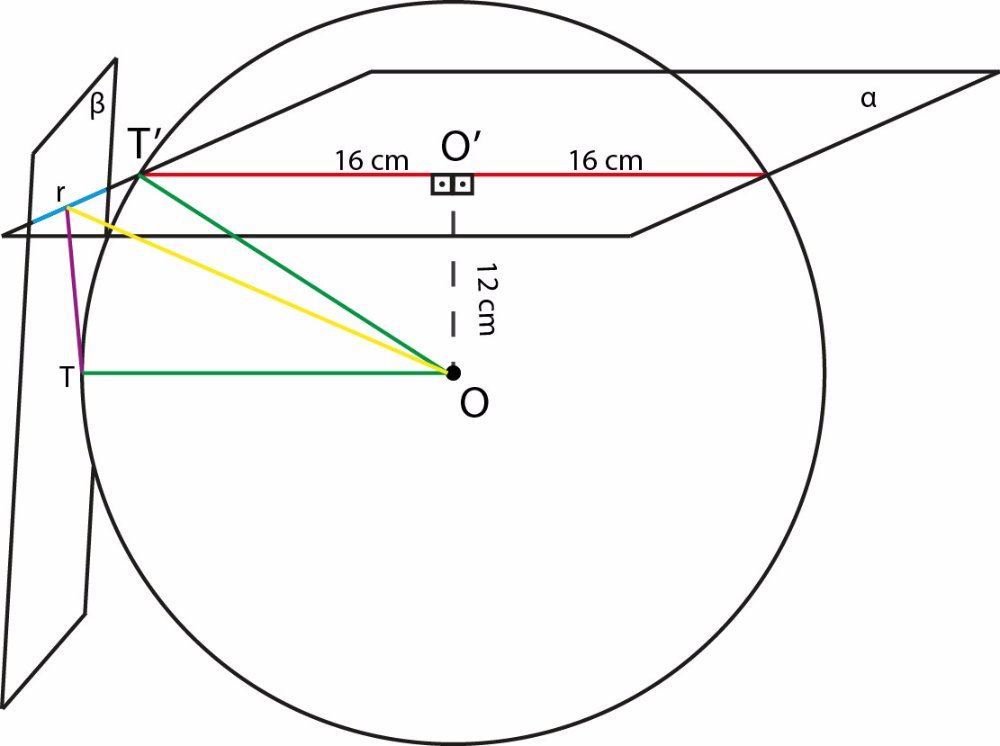
- DESENHOHARD.jpg (72.7 KiB) Exibido 1571 vezes
Está bem difícil de entender, eu sei, mas... né kk
A primeira coisa que tem de se lembrar é que uma distância entre ponto e reta é
[tex3]\perp[/tex3] à reta. Ou seja, a distância
[tex3]OO' \ = \ 12 \ cm[/tex3] é perpendicular ao diâmetro da circunferência formada pelo plano
[tex3]\alpha[/tex3].
Além disso,
[tex3]O'T'[/tex3] é um raio dessa circunferência, ou seja,
[tex3]O'T' \ = \ 16 \ cm[/tex3].
Por fim, [tex3]OT'[/tex3] é um raio da esfera.
Pitágoras em
[tex3]OO'T'[/tex3] [tex3]\longrightarrow[/tex3]
[tex3]OT'^2 \ = \ OO'^2 \ + \ O'T'^2 \ \rightarrow[/tex3]
[tex3]OT'^2 \ = \ 12^2 \ + \ 16^2 \ \rightarrow[/tex3]
[tex3]OT ' = \sqrt{400} \ \rightarrow \ \boxed{OT' \ = \ 20 \ cm}[/tex3] é o raio da esfera.
Como
[tex3]T[/tex3] é um ponto de tangência, existe um dos infinitos raios da esfera que é perpendicular à distância
[tex3]Tr \ = \ 48 \ cm[/tex3].
Ou seja, sendo
[tex3]OT \ = \ 20 \ cm[/tex3] um raio da esfera e
[tex3]Tr \ = \ 48 \ cm[/tex3] [tex3]\perp[/tex3] entre si, podemos montar um Pitágoras para achar
[tex3]Or[/tex3] [tex3]\rightarrow[/tex3]
[tex3]Or^2 \ = \ Tr^2 \ + \ OT^2 \ \rightarrow[/tex3]
[tex3]Or^2 \ = \ 48^2 \ + \ 20^2 \ \rightarrow[/tex3]
[tex3]Or^2 \ = \ 2704 \ \rightarrow[/tex3]
[tex3]Or \ = \ \sqrt{2704} \ \rightarrow[/tex3]
[tex3]\boxed{\boxed{Or \ = \ 52 \ cm}}[/tex3] é a distância do centro da esfera
[tex3]O[/tex3] à reta
[tex3]r[/tex3].
That's all I'd do all day. I'd just be the catcher in the rye and all.
"Last year's wishes are this year's apologies... Every last time I come home (...)"
Poli-USP
![🔴 [ENEM 2025 PPL Live 06] Matemática - Resolução de 161 até 165](/cdn-cgi/image/width=200,dpr=2,quality=85,format=auto,metadata=none,onerror=redirect/https://img.youtube.com/vi/ucQZ6Qn91JM/mqdefault.jpg)
![🔴 [ENEM 2025 PPL Live 05] Matemática - Resolução de 156 até 160](/cdn-cgi/image/width=200,dpr=2,quality=85,format=auto,metadata=none,onerror=redirect/https://img.youtube.com/vi/m2T1rBKy2qU/mqdefault.jpg)
![🔴 [ENEM 2025 PPL Live 04] Matemática - Resolução de 151 até 155](/cdn-cgi/image/width=200,dpr=2,quality=85,format=auto,metadata=none,onerror=redirect/https://img.youtube.com/vi/1scCX1e_dZo/mqdefault.jpg)
![🔴 [ENEM 2025 PPL Live 03] Matemática - Resolução de 146 até 150](/cdn-cgi/image/width=200,dpr=2,quality=85,format=auto,metadata=none,onerror=redirect/https://img.youtube.com/vi/fD8ohgS6JKo/mqdefault.jpg)
![🔴 [ENEM 2025 PPL Live 02] Matemática - Resolução de 141 até 145](/cdn-cgi/image/width=200,dpr=2,quality=85,format=auto,metadata=none,onerror=redirect/https://img.youtube.com/vi/np7jAEKAjTE/mqdefault.jpg)
![🔴 [ENEM 2025 PPL Live 01] Matemática - Resolução de 136 até 140](/cdn-cgi/image/width=200,dpr=2,quality=85,format=auto,metadata=none,onerror=redirect/https://img.youtube.com/vi/vb1b6e7VXjw/mqdefault.jpg)