Olá rui_miguel!!
Seja bem vindo ao forum!!
Na figura, dado o raio
[tex3]R,[/tex3] calcule o
[tex3]\ell_{10}[/tex3](lado do decágono regular).
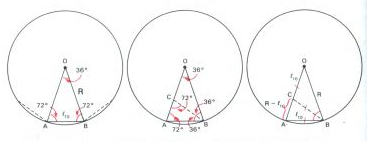
- A115.png (35.33 KiB) Exibido 9230 vezes
Sendo
[tex3]A\hat{O}B=\ell_{10},[/tex3] então
[tex3]A\hat{O}B= \frac{1}{10}.360^\circ=36^\circ \Longrightarrow \hat{A}=\hat{B}=72^\circ.[/tex3]
Conduzindo
[tex3]BC,[/tex3] bissetriz de
[tex3]\hat{B},[/tex3] vem:
[tex3]\Delta BAC[/tex3] é isósceles
[tex3](\hat{A}=\hat{C} = 72^\circ) \Longrightarrow \bar{BC}=\ell_{10}[/tex3]
[tex3]\Delta COB[/tex3] é isósceles
[tex3](\hat{O}=\hat{B} =36^\circ) \Longrightarrow \bar{OC}=\bar{BC}=\ell_{10}[/tex3]
Então:
[tex3]\bar{OC}=\ell_{10}[/tex3] e
[tex3]\bar{CA}=R-\ell_{10}[/tex3].
Aplicando o teorema da bissetriz interna
[tex3](BC[/tex3] é bissetriz no
[tex3]\Delta AOB),[/tex3] vem:
[tex3]\frac{\ell_{10}}{R}= \frac{R-\ell_{10}}{\ell_{10}} \Longrightarrow \ell_{10}^2 =R\cdot (R- \ell_{10}) \Longrightarrow \ell_{10} = \frac{-R\pm R\cdot \sqrt {5}}{2},[/tex3]
Desprezando a solução negativa que não convém,temos:
[tex3]\ell_{10} = \frac{\sqrt 5-1}{2}\cdot R[/tex3].
Obs.: O
[tex3]\ell_{10}[/tex3] é o segmento áureo do raio.
Espero ter ajudado....

______________
"Sem a Matemática, não poderia haver Astronomia; sem os recursos maravilhosos da Astronomia, seria completamente impossível a navegação. E a navegação foi o fator máximo do progresso da humanidade. (Amoroso Costa)"
![🔴 [ENEM 2025 PPL Live 05] Matemática - Resolução de 156 até 160](/cdn-cgi/image/width=200,dpr=2,quality=85,format=auto,metadata=none,onerror=redirect/https://img.youtube.com/vi/m2T1rBKy2qU/mqdefault.jpg)
![🔴 [ENEM 2025 PPL Live 04] Matemática - Resolução de 151 até 155](/cdn-cgi/image/width=200,dpr=2,quality=85,format=auto,metadata=none,onerror=redirect/https://img.youtube.com/vi/1scCX1e_dZo/mqdefault.jpg)
![🔴 [ENEM 2025 PPL Live 03] Matemática - Resolução de 146 até 150](/cdn-cgi/image/width=200,dpr=2,quality=85,format=auto,metadata=none,onerror=redirect/https://img.youtube.com/vi/fD8ohgS6JKo/mqdefault.jpg)
![🔴 [ENEM 2025 PPL Live 02] Matemática - Resolução de 141 até 145](/cdn-cgi/image/width=200,dpr=2,quality=85,format=auto,metadata=none,onerror=redirect/https://img.youtube.com/vi/np7jAEKAjTE/mqdefault.jpg)
![🔴 [ENEM 2025 PPL Live 01] Matemática - Resolução de 136 até 140](/cdn-cgi/image/width=200,dpr=2,quality=85,format=auto,metadata=none,onerror=redirect/https://img.youtube.com/vi/vb1b6e7VXjw/mqdefault.jpg)
![🔴 [ENEM 2025 Belém Live 09] Matemática - Resolução de 176 até 180](/cdn-cgi/image/width=200,dpr=2,quality=85,format=auto,metadata=none,onerror=redirect/https://img.youtube.com/vi/krrZ-ei9zSY/mqdefault.jpg)